OnlyFans auto-renew surprises appear when a creator rebuilds a page you already pay for. This guide explains the renewal logic that decides what happens to your subscription when prices, tiers, or page types change. The rules come from the platform contract, not creator preference, so once you understand the mechanics you can predict most billing outcomes before they hit your statement. BestOnlyFans tracks these shifts for the same reason.
The Fixed Auto-Renew Contract Between Platform and Subscriber
When you subscribe, you agree to a bundle: a price, a described content scope, and a renewal cadence. The creator can change the page the next day, but the terms you accepted still govern the current period.
Why Renewal Stops Suddenly
This is why renewal sometimes continues smoothly for months and then stops without warning. The trigger is the offer changing in a way the platform cannot map onto your original authorization.
- Base price at the moment of subscription.
- Content inclusion scope as described at purchase.
- Auto-renewal authorization tied to that specific offer.
- Access duration calculated from payment confirmation, not the calendar month.
Access duration deserves a pause. If you subscribe on the 27th, your period ends on the 27th of the following month. Creators who publish on a monthly drop schedule sometimes reference calendar months, which creates a mismatch between your perceived billing cycle and the recorded one.
The practical tip: screenshot the price and page description within minutes of subscribing. If the page changes later and a dispute arises, that screenshot is the clearest evidence of the offer you actually accepted.
Price Increases and Automatic Cancellation Mechanics
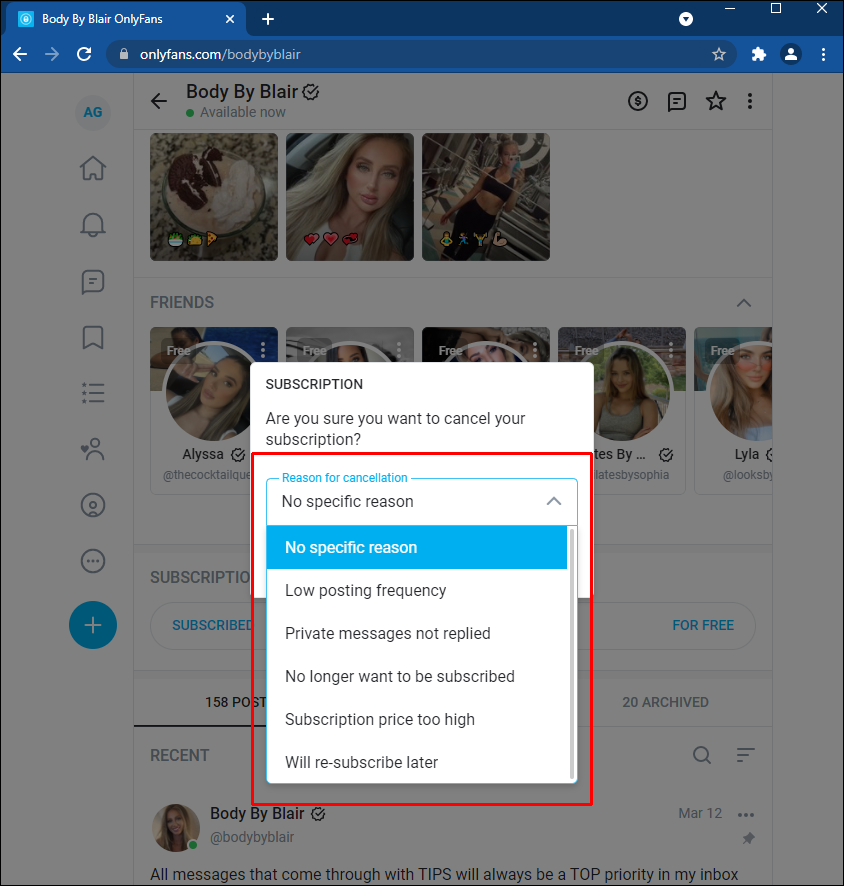
When a creator raises the base subscription price, auto-renew stops for existing subscribers. Current access continues until the period you already paid for expires, then the subscription ends unless you actively re-subscribe at the new price.
- The platform generates a cancellation notice to affected subscribers.
- The auto-renew flag is removed from the account.
- Current access timestamp is preserved until the original expiry date.
- A new subscription option appears at the modified rate with no default acceptance.
In reality nobody is cut off mid-period. The change concerns the next billing event, not the current one, and paid time is honored in full.
One nuance: promotional first months can legitimately sit below the $4.99 base minimum, such as a $3 first month. That is a first-month promotion, not a base price, and the renewal after it returns to the standard rate. Paid base subscriptions run from $4.99 to $49.99, with most pages clustering between $5 and $10.
Price Decreases and Passive Beneficiary Scenarios
The opposite scenario behaves asymmetrically, catching people who assume fairness runs both directions. A lower public price does not automatically replace the rate you originally agreed to pay.
Lowering the page price does not rewrite that consent retroactively, so the system has no instruction to charge you less. A creator can issue a promotional offer, cancel and invite re-subscription at the lower rate, or send a partial refund as goodwill.
For subscribers, one habit matters: if you see a public price drop that applies to new subscribers only, ask whether existing subscribers are included. A clear answer tells you a lot about how the creator handles their audience.
Revenue Split Structure
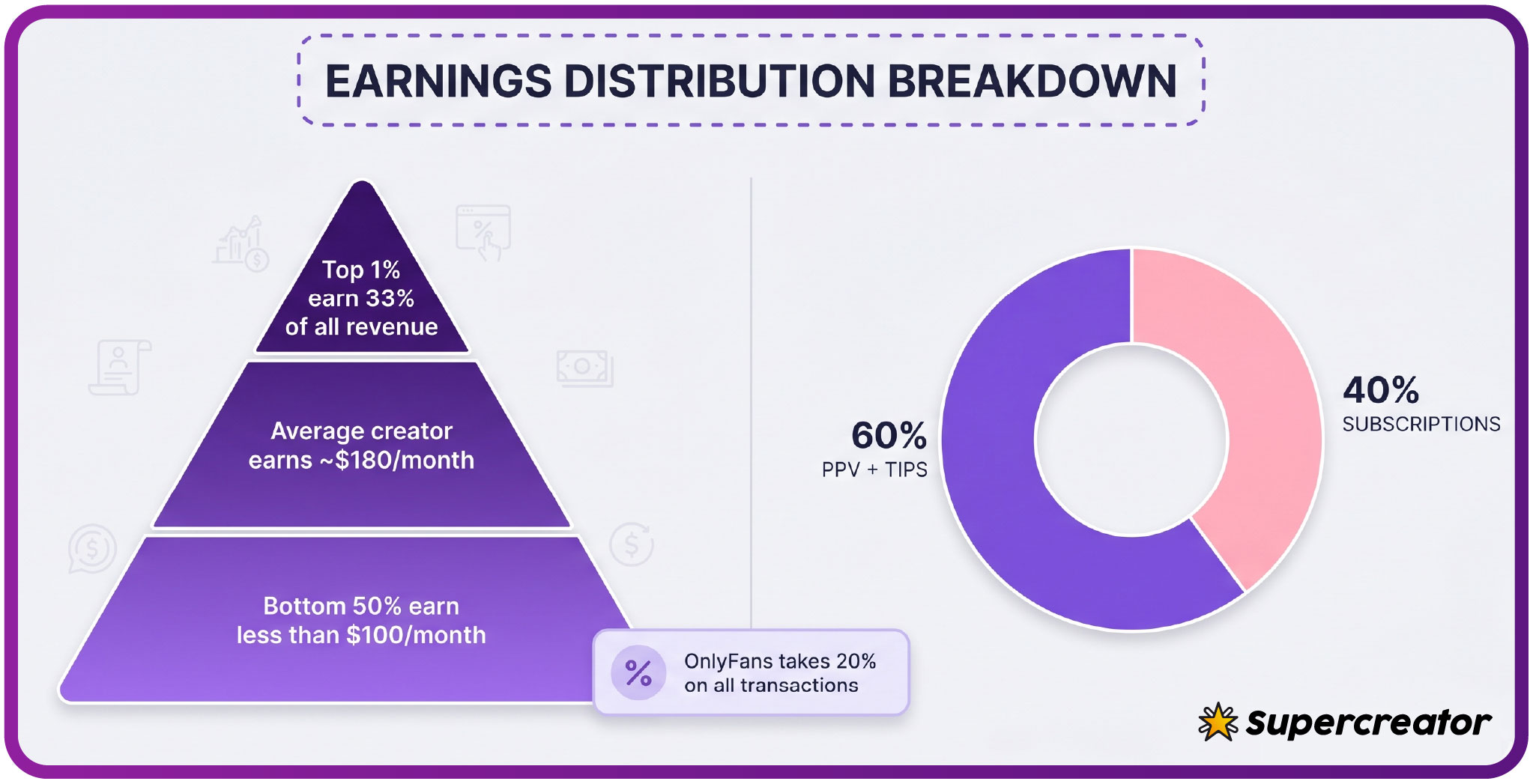
OnlyFans takes 20% on everything and the creator keeps 80%, whether the subscription costs $5 or $49.99. That consistency is one reason creators manage pricing themselves rather than relying on platform-level adjustments.
Content Tier Restructuring Without Price Changes
Here is the edge case that generates the most frustration, because the billing side stays stable while the value side shifts. A creator reorganizes what sits behind the paywall without touching the subscription price.
Common restructurings that test these mechanics include:
- Feed post frequency reduced and offset by promised PPV drops.
- Live stream access removed from the base tier and moved behind tips.
- Archive content deleted rather than preserved.
- Messaging response time guarantees quietly withdrawn.
- Custom request pricing moved from included to à la carte.
None of these trigger automatic cancellation. The practical defense is documentation and timing. If the value proposition changes materially, cancel before the next renewal and keep access through the period you already paid for. For broader context on how pages get evaluated over time, the BestOnlyFans methodology tracks these shifts alongside price history rather than treating a page as a static listing.
Free-to-Paid and Paid-to-Free Transitions
Page type conversions follow their own rules because the underlying product changes. A free page sets the price to $0 and earns through PPV messages and tips. A paid page charges a base subscription and typically includes more in the feed.
When a free page converts to paid, previously free followers generally do not retain access. They were never subscribers in the billing sense, so there is nothing to grandfather.
- Free-to-paid conversion typically requires a new subscription for previously free followers.
- Paid-to-free conversion often preserves the existing paid period without refund but ends auto-renew.
- Content access in free mode replaces the subscription feed with PPV dependency.
- Creators frequently launch a new paid page while keeping the free page as a funnel.
The paid-to-free case deserves attention. If you paid for a month and the creator flips the page to free on day five, your auto-renew stops and you are not charged again. You keep whatever access the free configuration provides, which may be less than what you bought.
On a free page, unlocking a PPV message can run up to $50, and paid chat commonly sits around $3 to $5 per message. A subscriber used to included content may find the new structure costs more per interaction than the old subscription did.
Reading BestOnlyFans Alerts for Structural Page Changes
Ranking sites exist because OnlyFans has no built-in discovery feed or directory. Without an external index, subscribers have no neutral place to compare pages or track how offers evolve.
A useful ranking entry shows price history rather than one current figure. When a page appears at $9.99, the question is whether it held that price for a year or moved from $4.99 three weeks ago. Price history answers that at a glance and acts as an early warning for subscribers whose renewal dates approach.
A page labeled subscription-based last month and PPV-driven this month has changed its earning model, which usually means the subscriber experience changed too. Tracking that transition on the ranking site is faster than discovering it through a disappointing renewal.
Change Frequency Signals
Change frequency is the third signal. A page that modifies pricing or structure repeatedly is one where calendar discipline pays off, because your renewal is more likely to land on the wrong side of a change.
Subscriber Response Options Across Change Scenarios
Once you know the rule that applies to your situation, the response becomes a choice rather than a reaction. The options below escalate in commitment, and most situations resolve well before the later stages.
- Passive lapse and evaluate at period end.
- Active cancellation with content archiving before access ends.
- Platform refund request for unmet explicit promises.
- Chargeback initiation for material service failure, with account termination risk.
- Public review or ranking site feedback to inform other subscribers.
| Change Type | Platform Rule | Subscriber Leverage |
|---|---|---|
| Price increase | Auto-renew stops, access runs to period end | High: no action needed to avoid overpaying |
| Price decrease | Existing rate unchanged automatically | Low: request promotional adjustment |
| Content scope reduction | Renewal continues if price unchanged | Moderate: cancel before next cycle |
| Page type conversion | Grandfathering limited; auto-renew ends | Moderate: verify access terms |
| Page deletion | Access ends with no renewal | High: refund request via support |
If you follow a specific niche closely, curation helps. Directories such as the best onlyfans blonde pages group creators by style so you can compare offers side by side before committing to a renewal.

Calendar Discipline Around Modification-Prone Pages
The idea is to review a page before the renewal date rather than after the charge, so any decision happens on your terms.
Start by recording the date you subscribed. That date is your billing anchor, and it never moves unless you cancel and re-subscribe. Every review you schedule should sit two or three days before that anchor.
| Risk Signal | Monitoring Frequency | Action Trigger |
|---|---|---|
| Price changed twice in six months | Weekly | Verify current rate before renewal |
| Content type volatility | Bi-weekly | Compare feed value to prior period |
| Creator tenure under six months | Bi-weekly | Watch for model pivots |
| Heavy promotional intensity | Weekly | Check whether offers exclude existing subscribers |
| Stable pricing, long tenure | Monthly | Routine confirmation only |
One more note on payment friction: card verification places a temporary $0.10 hold that is refunded within days. If a renewal fails around the same time you update payment details, that hold is usually unrelated and resolves on its own.
FAQ
If a creator raises their OnlyFans price, why does my auto-renew cancel automatically instead of asking me to confirm?
Your auto-renew consent was tied to the original price, so when that price changes the consent no longer applies. Rather than presenting a confirmation prompt, the system removes the renewal flag and lets your paid period finish. Re-subscribing at the new rate is a fresh decision you make actively.
Can a creator remove content I already paid for without reducing the subscription price?
Yes, within broad page terms. Content composition is treated as creator discretion, and the platform generally does not intervene when the subscription price is unchanged. Your leverage is timing: cancel before the next renewal and keep access through the period you already paid for. A refund request is more likely to succeed if you can show an explicit promise that was broken.
What happens to my remaining subscription time if a creator converts their paid page to free?
Auto-renew ends because there is no longer a paid offer to renew. Your remaining time is typically not refunded, and access continues under the free page configuration, which usually means the feed thins out and more content sits behind PPV. Unlocking those messages can cost up to $50 each, so the effective cost of the page can rise even though the subscription became free.
How quickly does the ranking site reflect page structure changes in its ranking data?
Ranking sites update on their own review cycles, so a change can appear anywhere from a few days to a few weeks after it happens on the platform. Treat ranking data as a strong early warning rather than a live feed. For anything tied to an imminent renewal, confirm the current price and structure directly on the page itself.